There are many processing software for planetary imaging, and many are excellents. But to finalise the processing, and whatever software I have used, I always go back to Registax 6 ! Here is why…
- Download Autostakkert 2 and 3 – Free planetary stacking software. – is a free software for planetary stacking developed by Emil Kraaikamp. It produce excellent and amazing stacking results with as little effort as possible. It’s certainly the most simple software to use. AS!2 or AS!3 uses its own recentrer.
- Dec 05, 2016 RegiStax is a free image processing software for amateur astrophotographers, released as freeware, which runs under Windows. A compatible version for Mac OS is also available as a emu file (see Download below) Its purpose is to produce enhanced images of astronomic observations through combining.
- Sep 27, 2019 When your image first loads into RegiStax it can look quite bland and blurry. If your image is a little dark when loaded, look to the Functions tab on the right-hand side of the program and click Histogram. Adjust the middle slider to the left to brighten the image. This will help you to see what is happening as you make adjustments.
Well, Registax didn’t like the idea of stacking only 2 images but I did it anyway and got a result that was a little sharper but grainier. Meh, it’s a tossup if you ask me. Anyway, here’s the second (stacked) image at 100% and 50%. Registax is designed to align and stack dozens or hundreds or more of similar images of planets and the moon. I'm not sure what you want to do with the eclipse images, but the eclipse is ever changing so you probably won't have a lot of extremely similar images, so stacking might not be a good idea. If you want to stack lunar images, I suggest.
is one of the best planetary processing softwares. I have always difficulties to perceive real differences between softwares when aligning or selecting frames but there is one step where Registax 6 looks unbeatable to me: the good enhancement of details. To me it is strong on two points: noise reduction, and resizing.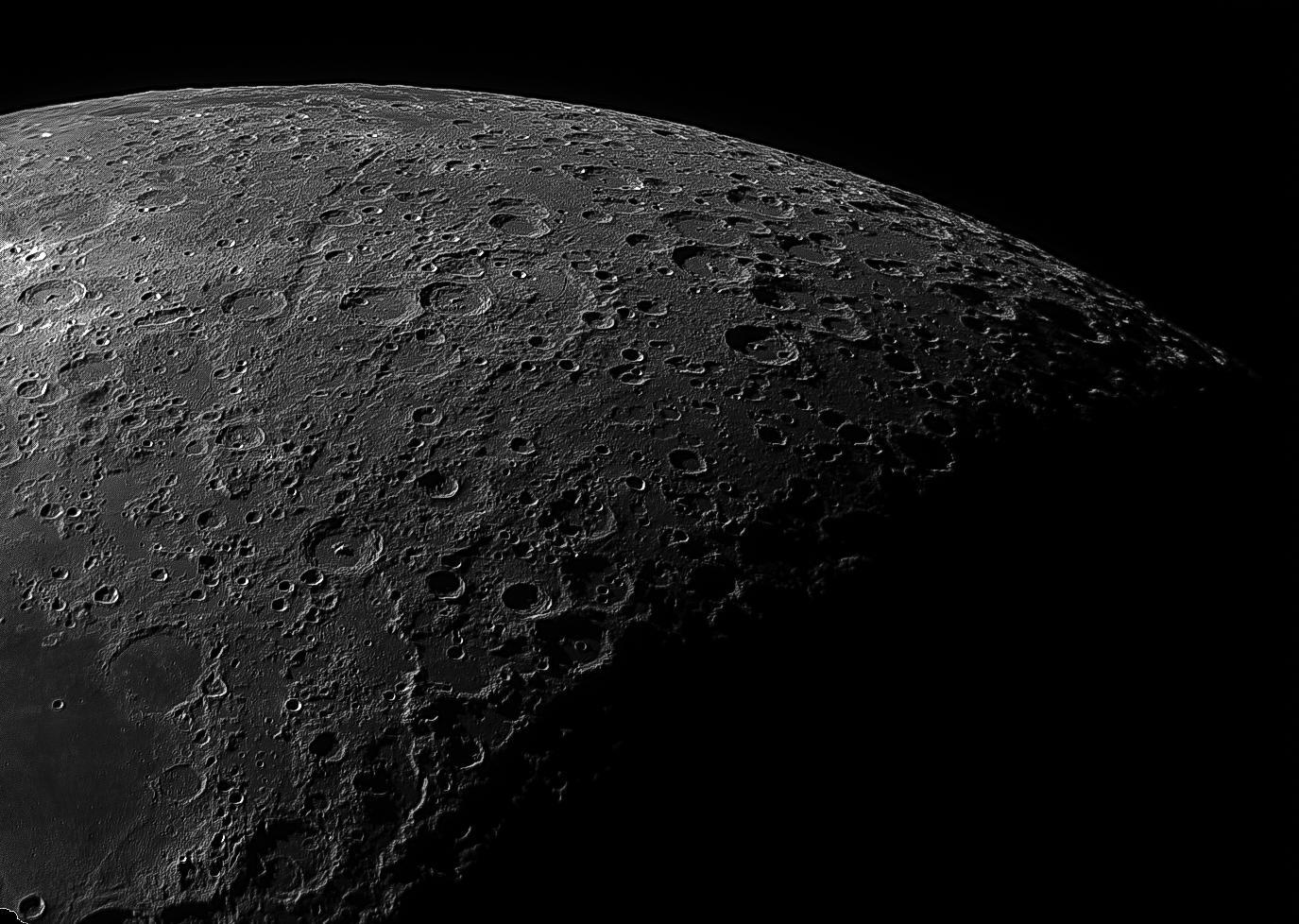 , the target and the conditions, but I first use the 2nd layer, then the 1st, partially the 3rd but never the 4/5/6.Push the sliders to the right to the point where the enhancement of details is nice to you. Here the 1 and 2 are set up to 100 % at first, but by using the Sharpen filter you can set them to more than 100 (here, 140 and 110 respectively).The result is well contrasted, but the image is too noisy !At this step you can use the gaussian filters with the Denoise filters at left.You can make them vary up and down with the arrows. The increment is then by step of 0,05, which is not very precise. You can refine directly the value inside the box, with a variation of one tenth (0,06 to 0,07…) but you can even go to one hundredth, like here at layer two (0,125).Take care of the smallest details: noise reduction must not erase them! Most of the time the value I used is under 0,1 (my processing was a bit hard here ;) )
Indeed, the main processing window already allows you to reduce noise. But the software offers as well different resizing filters to be chosen following your needs !
 Mars is a very small planet and benefits well from an enlargement…On the right menu, click on “Resize image” and this will open the dialog box. You can enlarge the image up to 200 % (you can also reduce it).Other options can be used – Flip X and Y can set right an inverted image. You can also adjust to the pixel the final size of the whole frame.But the most interesting tools are the different resizing filters at bottom left.Here are the effect of filters (click on the illustration to see its full content). They will offer a different level of smoothing so you can choose the more adequate. Lanczos looks to enlarge without effect on noise: this one is to be used for the very best images (or those one to be derotated under WinJupos). Then Mitchell and Bell show increasing levels of smoothing. Finally, B-Spline is the most efficient in noise reduction but beware that small details will be blurred as well! This one is to be kept for the most difficult images.As a last word, the resizing filters must be combined with the “Denoise” filter of the main window :). If for example the Mitchell filter looks to be too weak, before using Bell, just see if a slight increase of the denoise in the first layers do not solve the problem…
Astrophotography is closer to science than art, and there is no such thing as “getting it right in camera.” This means you cannot simply point the camera at the sky and snap away.
In astrophotography you cannot avoid post processing your images, so stacking and editing your images serves three main purposes:
- Reduce noise and deal with light gradients and vignetting.
- Improve signal to noise ratio.
- Reveal the faint details in the image.
Image stacking is the technique used to improve the signal to noise ratio, and it is the only noise reduction method that will boost the image details rather than smear them out.
In this article, we will discuss some of the most popular software available for astrophotography image stacking.
Note: Don’t miss the detailed video at the end of this article, It was created to help show you how to quickly start using some of the stacking software mentioned in this article.
Click here to skip to our Image Stacking Demo Video.
What Does Stacking Photos Mean?
The concept behind image stacking is simple, but to appreciate how it works, there are a couple of things we have to consider:
- A stack can be visualized as a pile of images all stacked one on top of the other;
- Each digital image is formed by a set of pixels, all having a certain value: dark pixels will have a lower value than the bright ones;
In the simplest form of image stacking, the pixels values for all images in the stack are averaged to produce a single image.
What is the purpose of stacking photos?
The result is a single image with improved signal to noise ratio, i.e., with better details and lower (random) digital noise and better details.
The scheme below illustrates the concept.
If the considered digital noise affects the pixel values randomly across the stack, then the result of averaging the stack is that the random component of the noise to the pixel value is significantly reduced.
ISO noise and Luminance noise and Chrominancenoise are examples of digital noises that are random.
The image below shows a real-life example from stacking 30 images from my Sony RX10 bridge camera taken at ISO 6400. As you can see, the original images showed a greater deal of noise (grain) than the stacked one.
The More Images You Stack, The Better
The more images you stack, the cleaner the resulting images are, as shown in the comparison below.
While Image stacking creates a cleaner image, it often softens the image: digital sharpening techniques are then used to recover sharp looking details.
Finally, bear in mind that the progression of image quality is not linear.
If stacking 4 images improves the image quality of 50% respect what you got by stacking only 2 images, to improve a further 50% the image quality from stacking 50 images, you may need to stack 300 images or more.
Image Stacking And Movement
If nothing moves between shots, like in the previous real life example, implementing image stacking is very simple: just group the images and average them to smooth out the noise.
With a moving subject, grouping and averaging the images will not only smooth out the noise, but also the subject itself.

This is the same principle for which long exposures of passing traffic and crowd result in a street image without cars nor people.
This effect is amplified with the number of images used, and the moving subject could simply disappear from the stacked image.
To resolve the issue, you have to align the images based on their content before stacking.
Due to image alignment, you may have to trim the edges of the stacked image to get rid of artifacts, but your target will not be lost.
Note that while in theory you can stack images of a static scene taken with the camera on a tripod, in reality, those images will probably differ at the pixel scale due to micro-movements. It is always beneficial to align the images before stacking.
How To Shoot For Exposure Stacking Your Images
Image stacking can be done with any camera and even camera phones and with images in both RAW and JPEG format.
Nonetheless, some things can be done to improve the final result:
- Lock the focus, so that the camera will not hunt for it between images. This will also help to keep the focus consistent through the shooting sequence.
- Keep the same settings, in particular shutter speed, aperture, and focal length: you don’t want to change the camera field of view during the sequence, nor the brightness of the images or the depth of field.
- If you are shooting on a tripod, disable image stabilization. If you want to shoot handheld, do so only for short sequences at very high shutter speed.
Image Stacking In Astrophotography
Related:Astrophotography Software & Tools Resource List
As said previously, image stacking is a standard technique implemented in any astrophotography editing workflow for,
- A star field from a fixed tripod.
- A deep sky object from a tracking mount.
- The Moon handheld.
- A starry landscape from a fixed tripod or tracking mount.
Every astronomy image will benefit from image stacking.
List Of Photo Stacking Software For Astrophotography
Here is a list of software used in astrophotography for image stacking.
Adobe Photoshop
Complete Image Editor | Commercial – Subscription Plan Photography Bundle $9.99 / Month | Mac OS X, Windows
Pro
- Versatile
- Available for Mac and Windows
- In bundle with Adobe Lightroom CC, Bridge, Camera Raw, and web space
- Many action packs and plugins available for astrophotography
Cons
- Subscription Plan only
- Can’t be used to calibrate light frames
- Stacking capabilities are somehow limited
If you are interested in photography, chances are you know Adobe Photoshop is the standard in the industry and does not need introductions.
With Adobe implementing a subscription plan for their applications, if you are using Lightroom CC for your everyday photography, your plan subscription will also include Photoshop CC and Bridge CC.
And for astrophotography, Photoshop is what you need. Lightroom cannot stack your images nor perform the histogram stretching, two crucial steps in the editing workflow for astrophotography.
In this article, we have already covered in detail how to stack astrophotography images with Photoshop.
Sequator
Deep Sky And Starry Landscape Stacker | Freeware | Windows
Pro
- Free
- Easy to use
- Fast
- Suitable for both Starry Landscapes and Deep Sky images
- Can create Star Trails
Cons
- Windows only
- Limited set of options
- Not suitable for Planetary astrophotography
Sequator is an easy-to-use and intuitive astrophotography software for stacking both starry landscape and deep-sky images. It can also be used to create star trails.
While not as advanced as other stackers, it nonetheless allows you to calibrate your light frames with dark and flat calibration frames. It also allows you to remove light pollution, reduce noise, and perform other simple tasks on the stacked image.
Starry Landscape Stacker
Starry Landscape Stacker | Commercial, $39.99 | Mac OS X
Pro
- Fast
- Easy to use
Cons
- Mac Os X only
- Does not read RAW files
If you are into starry landscapes and you are a Mac user, Starry Landscape Stacker is a must-have.
Easy to use, it allows you to stack and align the sky and the foreground independently by letting you easily mask the sky.
Unfortunately, the software lacks the support for RAW formats, thus forcing you to convert your RAW images in the more heavy TIFF format.
Aside from that, it works very fast and the final image is of good quality. You can also save the sky only, which is useful to further edit the shot in Photoshop or similar editors.
Starry Sky Stacker
Deep Sky Stacker | Commercial, $24.99 | Mac OS X
Pro
- Fast
- Easy to use
Cons
- Mac Os X only
- Does not read RAW files
- Basic
Starry Sky Stacker is Starry Landscape Stacker brother and it has been created to stack deep sky astrophotography images.
As Starry Landscape Stacker, Starry Sky Stacker is very easy to use and intuitive, although very basic.
If you are a casual star shooter and a Mac user, this could be a good choice for you.
Deep Sky Stacker
Deep Sky Stacker | Freeware | Windows
Pro
- Free
- Easy to use
- Fast
- Full light frames calibration
- Features Comet stack modes
- Can Drizzle
- Many advanced stack options and methods available
Cons
- Windows only
- Post-processing is quite limited
- Not suitable for Starry Landscapes nor for Planetary astrophotography
Deep Sky Stacker, better known as DSS, is arguably one of the most widely used software to calibrate and stack astrophotography images.
With DSS, you can fully calibrate your images with Darks, Flats, Dark Flats, and Bias calibration frames for the best results possible. Light frames are analyzed and scored by quality so that you can decide which percentage of best images you can stack (Best 75% by default).
A very interesting feature is that with DSS, you can easily combine images taken during different imaging sessions, to produce images of higher quality.
Autostakkert!
Planetary Stacker | Freeware | Windows
Pro
- Free
- Easy to use
- Suitable for Planetary, Lunar and Solar images
- Stack full planetary disk and lunar surface close-ups
Cons
- Interface a bit confused
- It does not offer wavelet sharpening
- Windows only
Autostakkert!, also known as AS!, is a very popular free software among the solar system astrophotographers. With AS! it is easy to stack both images showing the full Planetary (or Lunar or Solar) disc and images showing lunar surface close-ups.
The interface is a bit confusing, particularly in the beginning, but it is easy to navigate through the different steps for the stacking.
Unfortunately, AS! does not offer wavelet sharpening, which is a widely used technique in planetary and lunar astrophotography. For this, you can load your stacked image in Registax, another freeware software for Windows only that, sadly, is now “abandoned-ware.”
Lynkeos
Planetary Stacker | Freeware | Mac OS X
Pro
- Free
- Has deconvolution and wavelet sharpening
- It is probably the only freeware planetary stacker for Mac OS X
Cons
- Not very intuitive
- Somewhat slower than Autostakkert!
Lynkeos is perhaps the only freeware planetary stacker software for Mac OS X, sparing you from turning to Windows for using Autostakkert!.
The interface is quite intuitive to navigate, but not when it comes to performing the different tasks.
On the other hand, it offers a deconvolution method and wavelet sharpening, a must-have for a planetary stacker. Definitely worth having a look at it if you are a Mac user.
SiriL
Deep Sky Astrophotography Editor | Freeware | Mac OS X, Windows, Linux
Pro
- Free
- Cross-Platform
- Active development
Cons
- A bit convoluted and not as intuitive as other stackers
SiriL is a freeware, cross-platform, astrophotography package that will let you calibrate, stack, and develop deep sky astrophotography images.
While not as easy and intuitive as Sequator or DSS, it offers a lot of options and produces good results. There is an active community, and it is under constant development.
Astro Pixel Processor
Deep Sky Astrophotography Editor | Commercial $60/Yr Renter License Or $150 Owner License | Mac OS X, Windows, Linux
Pro
- Full-grown astrophotography package
- Fairly easy to use
- Mosaics are created with ease and are of great quality
- Active and constant development
- Cross-Platform
- 30-days Trial period
- Affordable yearly subscription
Cons
- Only for deep sky astrophotography
- No Comet stacking mode
With Astro Pixel Processor (APP), you step in the realm of full-grown astrophotography packages, with many advanced options and methods to calibrate, stack, and post-process your deep-sky images.
Compared to PixInsight (PI), the software benchmark for the category, APP is cheaper and way easier to use, which makes it one of the best PI alternatives.
Registax 6
If you decide to buy it, you can choose between the renter’s license for $60/yr, to always get the latest version of APP, or the owner’s license for $150, but you will have to purchase the license again for major update releases.
PixInsight
Astrophotography Editor | Commercial – €230+VAT | Mac OS X, Windows, Linux
Pro
- It has all you need for astrophotography
- 45 days trial period
- A lot of tutorials and information available
Cons
- Expensive and without subscription plan
- Extremely steep learning curve
- Long and convoluted process
- Needs a powerful computer
When it comes to astrophotography, PixInsight is the software of reference against which all others are measured. It offers everything you may possibly need to produce pro graded images, and it is objectively the best software in the field.
But user experience can be frustrating, as the learning curve is very steep, the editing is long and convoluted, and your computer must be quite recent and powerful to make it run smoothly.
The €230 + VAT price tag is also quite steep: sure it is worth every penny, but this makes PI be even more the software of choice for professional and keen amateur astrophotographers.
A Comprehensive Demo About Image Stacking
In this video, I show you how easy it is to wet our feet with image stacking.
This is particularly true if you use Starry Landscape Stacker, Sequator, Deep Sky Stacker and Autostakkert!, as I showed in the video below.
Conclusion
Registax 3
Image stacking is one of the crucial steps in the astrophotography editing workflow.
You’ll need the appropriate stacker for each type of astrophotography: starry landscapes, star trails, or deep-sky and planetary images.
How To Use Registax
In this article, we have covered the most popular astrophotography stackers available on the market, both freeware and commercial.
Registax Moon Tutorial
And while Windows users have the more extensive choice, some notable stackers are available for Mac and even Linux users.